
A “clean” label can sound reassuring, but it won’t tell you whether a snack fits your preferences. Clean ingredient snacks are best judged by what’s actually in the package, not by health-sounding claims on the front. “Clean label” isn’t a regulated FDA standard, so the phrase alone doesn’t give you a consistent way to compare products.
If ingredient lists feel hard to scan and claims seem to promise everything at once, focus on a few details you can compare: serving size, the ingredient statement, and added sugars. A useful choice doesn’t have to mean sacrificing taste or convenience. This guide shows you how to read package information and decide what matters to you, without treating any one phrase as a guarantee of health.
Topas Chin Chin describes its handcrafted Nigerian chin chin as preservative-free and made with natural ingredients. Its family recipe offers context about the snack, while the ingredient statement and Nutrition Facts are where you can review product details for yourself.
Key Takeaways
- Decide which ingredient preferences matter most to you; there’s no single checklist that defines every clean snack.
- Compare clean ingredient snacks by checking package details alongside flavor, texture, and convenience, rather than trusting a front-label claim alone.
- Use a repeatable label-reading process to move from broad marketing language to information that helps you make a considered choice.
- Prioritize the qualities you care about instead of searching for one universally “best” snack.
- Topas Chin Chin’s Nigerian heritage, family recipe, and stated ingredient approach offer one example, not a standard for every snack.
What Are Clean Ingredient Snacks, and What Does the Phrase Really Mean?
Clean ingredient snacks are snacks people choose because their ingredients align with personal preferences, not because the phrase guarantees they’re healthier. One shopper may look for familiar ingredient names, another may focus on dietary needs, and someone else may prefer to avoid certain additives. The term can point to different priorities, so it doesn’t describe one universal recipe or standard.
That distinction matters when you’re comparing packages. Ingredient statements and Nutrition Facts provide details to assess, while phrases such as “clean” or “wholesome” are broad promotional language. A front-label claim may communicate a brand’s positioning, but it doesn’t tell you everything about the product or prove an implied health benefit. Read the full package, then decide whether its details fit your needs.
Why “clean ingredients” can mean different things to different shoppers
Some people use “clean” to mean recognizable ingredients. Others prioritize a particular dietary preference or want to limit certain additives. These preferences are personal, not universal. The term Clean label is commonly used in marketing for foods perceived as simple or wholesome, but it isn’t a regulated definition that gives every shopper the same checklist.
Make your own short checklist before you shop. Which ingredients or package details do you want to understand? What matters most for your diet or everyday routine? With those priorities in mind, you can compare products on relevant details instead of letting a vague claim make the decision for you.
Ingredient choices are only one part of enjoying a snack
A snack also has to suit the moment. You might care about its flavor, whether you enjoy a crisp or tender texture, how easy it is to bring along, or whether it feels familiar and meaningful. These considerations can sit alongside ingredient preferences. Choosing a snack is personal, and enjoyment belongs in the decision too.
A short ingredient list isn’t automatically more nutritious, appropriate for every diet, or a better fit for every person. Ask whether the package details meet your needs and whether you’ll enjoy eating the snack. That leaves room for foods rooted in culinary traditions as well as newer choices. For a closer look at a beloved Nigerian snack and its background, explore what chin chin is.
How to Separate Ingredient Facts from Clean-Label Marketing
A package can offer a useful clue without telling the whole story. Separate three things: the claim printed prominently on the package, the product information in its ingredient statement and Nutrition Facts, and your interpretation of whether those details fit your preferences. Keeping these distinct helps you assess clean ingredient snacks without turning a marketing phrase into a health conclusion.
For example, “preservative-free” describes one product attribute. It doesn’t explain every ingredient, the snack’s nutrition, or whether it suits every person. Topas Chin Chin describes its handcrafted batches as preservative-free and made with natural ingredients. Those claims can guide what you look for, while the package details help you assess the product for yourself. A product claim describes a specific attribute; it doesn’t, by itself, establish a broader health benefit.
Which parts of the package should shoppers compare?
Start with the ingredient statement and Nutrition Facts panel. The ingredient list tells you what the package says is in the product, with ingredients generally listed by weight in descending order. The Nutrition Facts panel includes information such as serving size and added sugars. Read both, since neither tells the full story alone.
For a fair comparison, look at equivalent information across products. Check serving sizes before comparing Nutrition Facts. If the serving amounts differ, use a consistent amount as your reference. Then check whether the ingredients and nutrition details align with the priorities you chose, rather than letting one prominent phrase settle the question.
Why a “natural” or “clean” claim is not the whole story
Broad words like “natural” and “clean” can prompt a closer look, but they don’t tell you exactly what a product contains or guarantee a particular benefit. Harvard T.H. Chan School of Public Health discusses clean eating as a popular eating style, while emphasizing the need for a balanced view of the idea. Use a claim as a starting point, then compare it with the information on the package.
Don’t assume an unfamiliar ingredient is harmful, or that a familiar-sounding one makes a snack beneficial. Ask what you can verify: Is the detail on the package? Does it answer a preference or need that matters to you? Does the nutrition information add context? These questions turn a vague impression into a considered choice.
To see how these ideas apply to a specific snack, explore Topas Chin Chin’s handcrafted Nigerian chin chin and consider its package information alongside your own preferences.
How to Compare Clean Ingredient Snacks Without Losing Sight of Taste
There isn’t one snack that will be the right choice for everyone. A useful comparison starts with your own priorities, then considers what you’ll enjoy eating and how the snack fits your day. Apply the same criteria to each option, and use the package details for the product in front of you rather than assuming one claim applies to every version.
A practical comparison framework for packaged snacks
Before browsing, jot down the ingredient preferences that matter most. Then compare each snack using its ingredient list and Nutrition Facts. Check serving information on each package so you’re comparing like with like. Use flavor, texture, and convenience to capture your preferences, not as measures of ingredient quality.
| What to compare | Questions to ask |
|---|---|
| Ingredient fit | Do the listed ingredients align with the preferences you wrote down? |
| Package information | Have you reviewed the ingredient statement and Nutrition Facts, using comparable serving information? |
| Flavor | Does the flavor sound appealing for the occasion or people you’re sharing with? |
| Texture | Would you enjoy a crisp, crunchy, chewy, or tender bite? |
| Convenience | Does the package suit how and where you plan to enjoy the snack? |
Use the table as a guide, not a scorecard. You might treat one ingredient preference as essential and flavor as a close second, while someone else may prioritize portability or a familiar taste. If package information is missing or unclear, don’t fill in the gap with assumptions based on the front label.
How to balance ingredient preferences with enjoyment
Choose a few criteria you can apply consistently to every option. That keeps a polished claim or short ingredient list from becoming the whole comparison. A snack can fit your preferences and still need to appeal to your palate. Cultural familiarity, the pleasure of sharing, and convenience can matter alongside package details.
Chin chin offers one example of a snack with cultural roots and a satisfying crunch. Explore the chin chin variety pack to discover its flavors. Keep your own criteria in view: ingredient fit, package information, and the kind of snack experience you enjoy. That’s a more useful guide than searching for a universally “best” choice.
A Simple Step-by-Step Way to Read Snack Labels
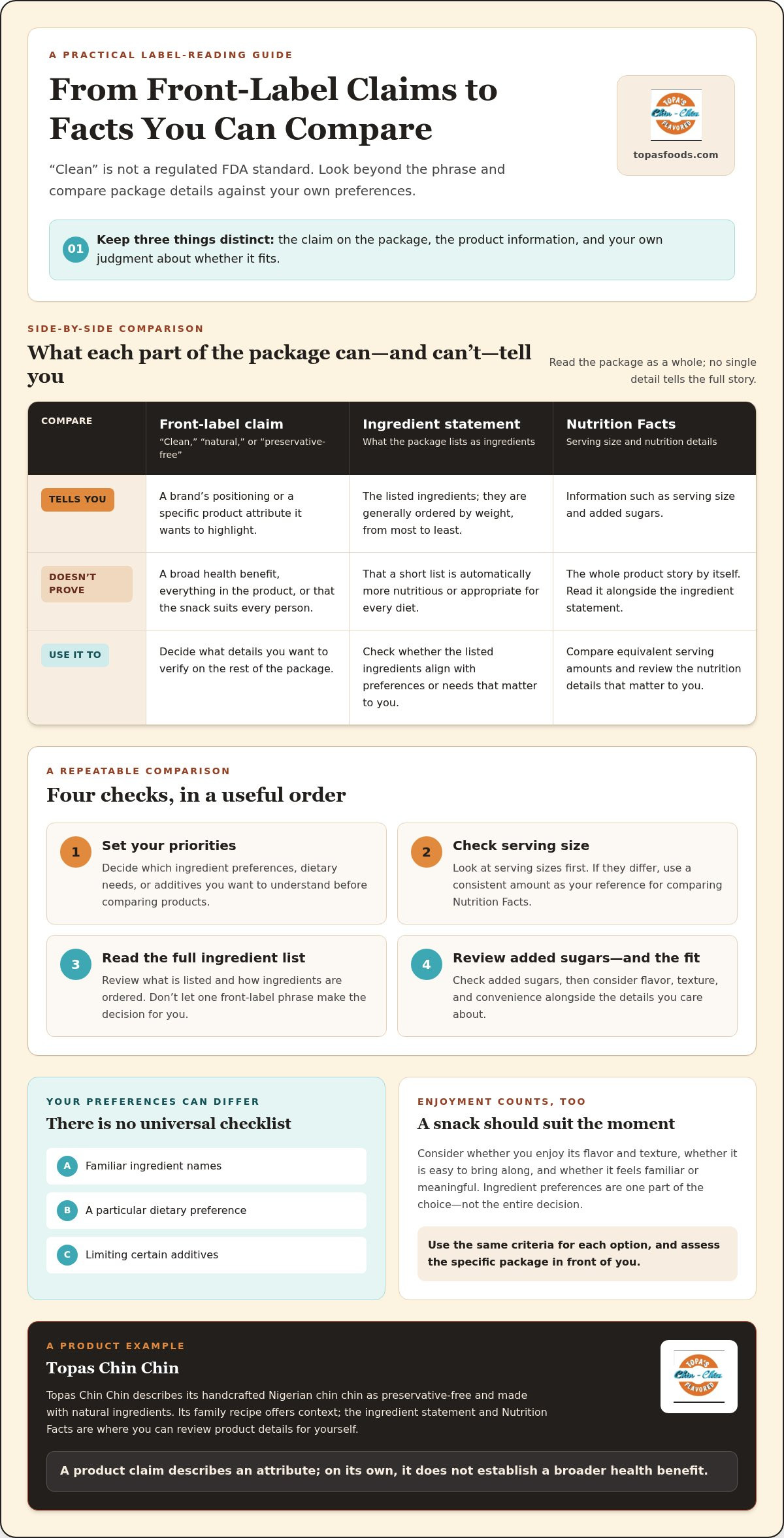
Make the package work for you. Start with what you want from a snack, then move from front-of-package wording to the details that can help you decide. This process keeps your personal preferences in focus without treating a label as medical advice or a promise about health.
A practical rule: name your priorities, check the full package, compare equivalent information, then choose the snack that best fits your needs and enjoyment.
Start with your priorities, then check the package
Use these steps the next time you’re comparing clean ingredient snacks:
- Start with your needs. Write down the ingredient preferences or package details that matter to you. Focus on your own choices rather than assuming everyone should seek or avoid the same things.
- Look past the front. Treat words such as “clean” or “natural” as prompts to look closer. Turn the package over or open its full product information online to find the ingredient statement and Nutrition Facts.
- Read the ingredient statement. Review the listed ingredients and note whether the information aligns with the priorities you identified. The ingredient list describes what’s stated for that product; it doesn’t, on its own, determine whether the snack suits every person.
- Check the Nutrition Facts. Look at the serving size before reviewing nutrition information, including added sugars. The serving size provides context for understanding the figures on the panel.
Use the information shown on the specific package you’re considering. Product details can differ, so don’t assume a claim or ingredient statement from one snack applies to another, even within a similar category. If a detail you care about isn’t clear, avoid filling in the blank with an assumption or a health conclusion.
Compare, decide, and revisit your choice
Compare similar snacks using the same priorities each time. That makes meaningful differences easier to spot and keeps you from being swayed by whichever package uses the most persuasive wording. Then consider the eating experience: a flavor you look forward to, a texture you enjoy, and a format that fits your day can all contribute to a satisfying choice.
There’s room for ingredient awareness and enjoyment at the same table. A familiar snack may feel right for sharing or reconnecting with a food tradition; convenience may matter on a busy day. Neither consideration replaces reading the package, but both belong in a personal decision.
Revisit your choice if your preferences change or the product information is updated. For a snack made with a family recipe, explore Topas Chin Chin’s Nigerian chin chin and use the same thoughtful approach to its package details.
How Topas Chin Chin Brings Ingredient Awareness and Purpose Together
Ingredient awareness is personal, and one brand’s approach can be an example without becoming a rule for every shopper. Topas Chin Chin makes handcrafted Nigerian chin chin using a family recipe. The company describes its batches as preservative-free and made with natural ingredients. These details offer context about the snack, but they don’t define clean ingredient snacks or, on their own, establish a broader health benefit.
A family recipe, seven flavors, and an ingredient-aware choice
A family recipe and handcrafted approach speak to the care and tradition behind a snack. Topas Chin Chin offers Original, Coconut, Cinnamon, Mocha Cappuccino, Banana, Vanilla, and Strawberry Chin Chin. The flavor names give shoppers options to explore, but they aren’t a substitute for product-specific package information.
If you’re considering a particular flavor, read its package for the ingredient statement and Nutrition Facts. That’s the practical way to assess its details against your preferences, rather than assuming every flavor has the same ingredients or nutrition information. Craft, heritage, and ingredient awareness can sit together, while each answers a different question.
Enjoying a snack that also carries a community purpose
A snack can bring more than flavor to the table. Topas Chin Chin is a family-owned business, and its proceeds support families in need, helping put food on tables and send children back to school. That mission adds purpose to the brand story, while ingredient choices and community values remain distinct parts of the decision.
The snack itself remains central: a crisp bite, a flavor that feels inviting, a bowl shared among family or friends. Nigerian chin chin brings its own culinary history and a welcoming spirit to a snack moment. To learn more about the company’s mission, read the social impact snack brand story.
Explore the flavors and family recipe behind them at Topas Chin Chin.
Choose Your Next Snack with Confidence
Choosing clean ingredient snacks doesn’t mean following one universal checklist. Start with the ingredient preferences that matter to you, read the package details rather than relying on a front-label promise, and compare snacks using consistent criteria. Then make room for flavor, texture, and convenience. A thoughtful choice should fit your preferences and be something you’ll enjoy.
Topas Chin Chin offers one example of how craft and purpose can accompany a snack. Its handcrafted Nigerian chin chin is made using a family recipe and comes in seven flavors, along with a Variety Pack and Mega Jar. The company’s proceeds support families in need. These details add context to the brand, while the package remains the place to review product-specific information.
Ready to explore the flavors? Shop Topas Chin Chin’s handcrafted Nigerian chin chin and choose a flavor, Variety Pack, or Mega Jar to enjoy or share.
Frequently Asked Questions
What are clean ingredient snacks?
Clean ingredient snacks are snacks shoppers consider aligned with their own ingredient preferences, such as choosing recognizable ingredients or avoiding particular ingredients. The phrase doesn’t have one universal meaning, so it isn’t a complete description of a snack. Check the product’s ingredient statement and Nutrition Facts, then decide whether the details suit your preferences. A broad front-of-package phrase can be a reason to look closer, but it can’t replace reading the package.
Are clean ingredient snacks healthier?
Not automatically. “Clean ingredient” is a broad phrase, not a full account of a snack’s nutrition or suitability for every person. Review the ingredient statement and Nutrition Facts, including the serving size, and consider your own needs and preferences. A short ingredient list, a natural-sounding claim, or the absence of one ingredient doesn’t establish that a snack is healthier overall. Use the package details to inform your choice, not as a health guarantee.
How can I tell if a snack has clean ingredients?
First decide what “clean ingredients” means for you. Then read the full ingredient statement and Nutrition Facts instead of relying on a front-label claim alone. Compare similar snacks using the same personal criteria and equivalent serving information, and refer to the package for product-specific details. This repeatable approach helps you assess clean ingredient snacks based on what matters to you, without treating a single phrase as a guarantee or a universal standard.
Does clean label mean the same thing as preservative-free?
No. These phrases don’t describe the same attribute. “Preservative-free” refers to a specific claim about preservatives, while “clean label” can reflect different ingredient preferences or brand messaging. Neither phrase tells you every detail about a snack. Read its full ingredient statement and Nutrition Facts, and don’t infer nutrition, suitability, or other product qualities from one claim. Use the current package information to guide your assessment.
Are snacks made with natural ingredients always a better choice?
No. “Natural” by itself doesn’t tell you everything about a snack or whether it fits your preferences. Review the complete ingredient statement and Nutrition Facts, then consider how the snack suits your needs and the occasion. Flavor, texture, and convenience matter too. A balanced comparison looks at specific package information rather than assuming that a broad description guarantees a particular benefit or makes the snack right for everyone.
Are Topas Chin Chin snacks made with natural ingredients?
Yes. Topas Chin Chin describes its handcrafted Nigerian chin chin as made with natural ingredients, and its batches as preservative-free. The seven flavors are Original, Coconut, Cinnamon, Mocha Cappuccino, Banana, Vanilla, and Strawberry. Flavor names don’t confirm specific ingredients or nutrition information. For the details of a particular flavor, read its package, including the ingredient statement and Nutrition Facts, and compare them with your own preferences.


