
What can a crunchy bite tell you about the food traditions behind it? Culturally inspired snacks offer a way to explore distinctive flavors and textures alongside the stories connected to them. The phrase can feel broad, especially when a package names a flavor but gives little context about its roots.
You don’t need to know everything before taking a first bite. Start with curiosity: learn the snack’s name and background, listen to people who know its traditions, and remember that one food offers a glimpse, not a complete portrait. Nigerian chin chin, which Topas Chin Chin makes from a family recipe, is one specific snack to explore, not a stand-in for all Nigerian food.
This article explains what makes a snack culturally inspired, how to discover and share unfamiliar foods with care, and how a pleasurable crunch can lead to a richer story. It also looks at how sharing food can connect enjoyment with community, including Topas Chin Chin’s stated mission to support families in need.
Key Takeaways
- Explore culturally inspired snacks by looking beyond flavor to their origins, preparation, and place in food traditions.
- Use a snack’s name, ingredients, texture, and serving customs as clues to its culinary story.
- Look for specific cultural context, and avoid treating one snack as representative of an entire culture.
- Approach unfamiliar foods with curiosity: learn their context, notice the sensory details, then share what you discovered.
- Nigerian chin chin is one specific starting point for exploring how a family recipe can carry food heritage forward.
What Are Culturally Inspired Snacks, and What Makes Them Meaningful?
Culturally inspired snacks connect an everyday pleasure to a larger food story. Their meaning may come from where a snack originated, how it’s prepared, the ingredients and techniques it uses, or the way people share it. Some are rooted in living traditions passed among families and communities. Others borrow a flavor or name as inspiration without sharing the same history or role.
That distinction matters. A familiar spice or flavor reference can make a snack intriguing, but it doesn’t explain the food’s origins, how people traditionally enjoy it, or what it means to those who know it well. To explore thoughtfully, look beyond the label. Learn the snack’s name and context, stay curious about differences, and don’t expect one bite to tell a whole culture’s story.
How culture, memory, and everyday snacking meet
Food traditions live in ordinary moments as well as special occasions. A snack shared during a family visit, set out for a celebration, or enjoyed as part of a daily routine can become tied to memory and belonging. Its taste may bring back a particular kitchen, a familiar voice, or the feeling of being welcomed.
There isn’t one version in every home. Recipes and customs can shift between households and generations as people adapt, preserve, and pass them on. One family may prepare a food differently from another, and neither version tells the full story of a national cuisine.
Cultural roots versus a flavor-inspired product
A flavor reference is a starting point, not a full explanation. To learn about a snack’s cultural roots, seek context about its name, origins, preparation, and place in everyday life or sharing. Traditional foods and dishes can be linked to identity and passed between generations, while traditions continue to change.
When a product draws on a cultural flavor, that alone doesn’t establish a connection to the food tradition behind it. Specific, thoughtful context helps explain what’s being referenced and where the inspiration comes from, without reducing a diverse culture to a shorthand.
Context gives flavor a story, while leaving room for that story to be more than one snack. As you explore, notice what you know and what you’re still learning. Consider whose perspective could deepen your understanding. This approach makes unfamiliar foods less like novelties and more like invitations to learn.
How Ingredients, Texture, and Tradition Shape a Snack's Story
A snack’s culinary character comes through in more than its flavor. Ingredients show what it’s made with; preparation, shape, and texture can offer clues about how it’s crafted and enjoyed. A crisp bite, gentle sweetness, or familiar aroma can make a food memorable, but these sensations are starting points for curiosity, not proof of its history.
Ingredient choices may reflect wider food traditions as well as the tastes and resources of a particular household. A family recipe may preserve a familiar approach, while another family adapts it to suit its preferences. Food also carries personal and shared meaning: the University of British Columbia explores how food shapes our identity and creates opportunities for cultural exchange. Keeping that connection in mind can make tasting more thoughtful.
What sensory details can tell you, and what they cannot
Pay attention to details you can experience directly. Is the texture crisp or tender? Does sweetness come through first, or do you notice an aroma before the first bite? Is the snack shaped for sharing or for a single serving? Describe what you observe in clear, welcoming language. “Crisp with a delicate sweetness” tells readers more than a broad label like “exotic.”
Keep tasting impressions separate from historical claims. Your experience can describe what a snack is like to you, but its origins and cultural meaning call for context from reliable information or people connected to the tradition.
Why family recipes and food traditions keep changing
Recipes travel through kitchens, generations, and changing circumstances. A household may adjust ingredients or preparation over time while keeping a beloved food recognizable. That variation doesn’t make one version the only authentic one; it reflects the living nature of food traditions.
Nigerian chin chin is one specific example. Topas Chin Chin makes handcrafted chin chin from a family recipe, offering a way to learn about this snack without treating it as a summary of Nigerian cuisine. Read the guide to what chin chin is for more context, then notice its crisp crunch for yourself. You can also explore Topas Chin Chin and this family-recipe example.
Authenticity and Cultural Inspiration: How to Explore Without Oversimplifying
A snack can introduce you to a food tradition, but it can’t represent an entire culture. Authenticity isn’t a universal checklist of ingredients or techniques. It may involve a food’s origins, how it’s prepared, family history, and the ways communities make it their own. Details can vary, and that variation doesn’t automatically make one version more or less authentic than another.
For culturally inspired snacks, specific context is more useful than sweeping claims. Naming a particular food and explaining what’s known about its roots gives readers something meaningful to learn, without suggesting that every family shares the same recipe or custom.
What respectful cultural food descriptions include
Start with the food’s name. Add relevant context about its origins, preparation, or family connection, and distinguish known information from your own tasting impressions. For example, Topas Chin Chin describes its Nigerian chin chin as handcrafted from a family recipe. That’s a specific detail about this snack and its makers, not a claim about every chin chin recipe or Nigerian household. For more about this particular food, read the story of original chin chin.
How to avoid flattening a diverse food culture
Countries and continents include many communities, histories, and foodways. Avoid using one dish to make broad claims about a whole nation, or treating distinct traditions as interchangeable. Present each snack as an individual example and leave room for regional, household, and generational differences.
A simple comparison shows the difference:
| Specific context | Generic shorthand |
|---|---|
| “This is Nigerian chin chin, made by Topas Chin Chin from a family recipe.” | “This snack represents African food.” |
| “Recipes and preferences can differ among households.” | “Everyone in the culture makes it the same way.” |
| “The maker describes this as a family-recipe version.” | “This is the only authentic version.” |
Specific descriptions tell readers what the example is and where its context comes from. Broad claims turn a varied food culture into a single story. Stay curious, name what you know, and be clear about what you don’t. That’s a welcoming way to appreciate a snack while respecting the people and traditions connected to it.
How to Discover and Share Culturally Inspired Snacks Thoughtfully
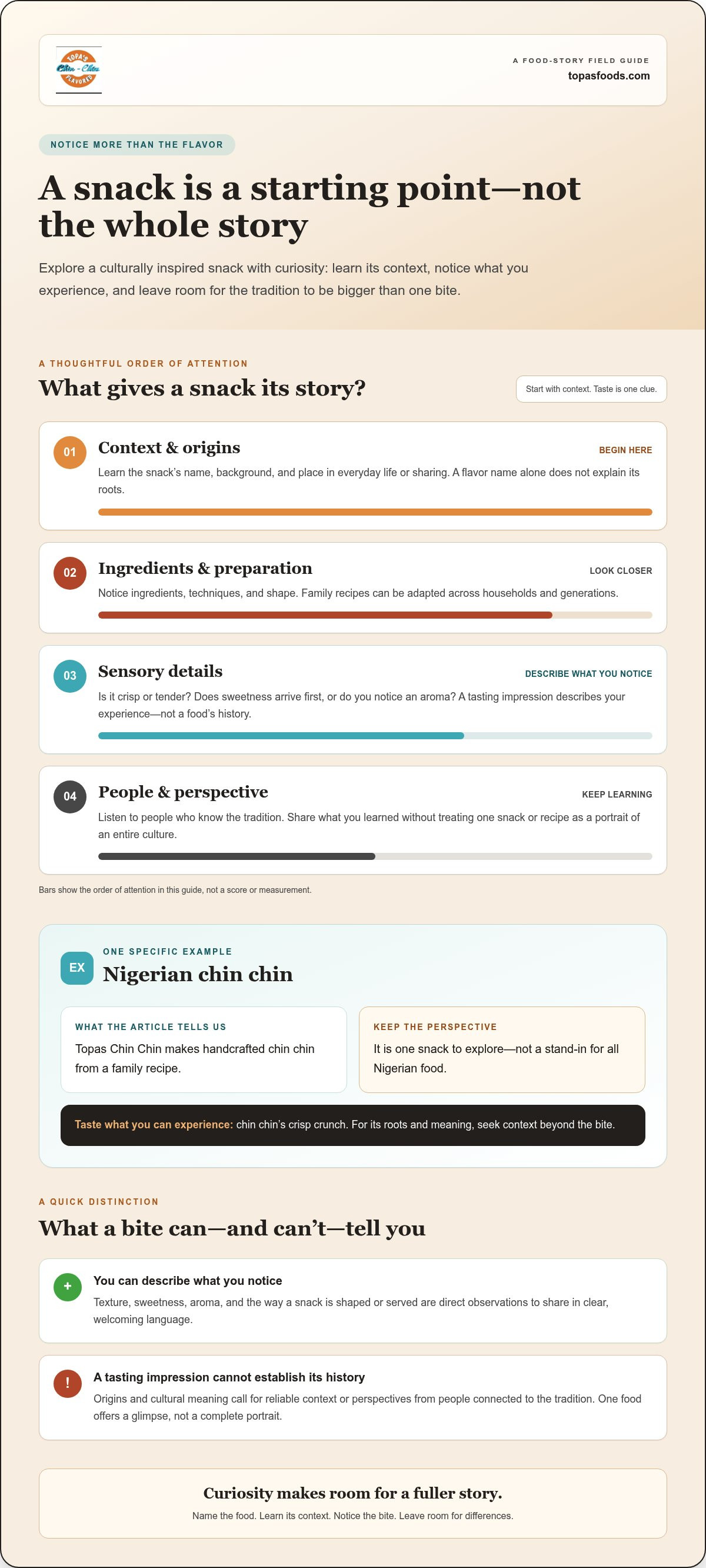
Curiosity is a good place to begin. Rather than treating an unfamiliar snack as a novelty or taste-test challenge, approach it as an invitation: learn its name, find some context, enjoy the experience, and share what you’ve learned with care. This sequence makes discovery more meaningful without turning every bite into a lesson.
A simple four-step way to approach an unfamiliar snack
- Start with its name. Learn what the snack is called and, when the information is available, which food tradition or community it’s connected to.
- Find some context. Look for reliable information about its origins, preparation, or how it’s enjoyed. Remember that recipes and customs can vary.
- Notice your own experience. Pay attention to flavor, texture, aroma, and serving style. Describe what you taste without suggesting that your impressions define the tradition.
- Share one useful detail. Tell others what you learned, and leave space for them to explore the snack in their own way.
Keep ingredient questions separate from cultural context. If you want to understand what’s in a snack or how to assess its ingredient information, this guide to clean ingredient snacks offers a separate place to start.
Make a shared tasting feel welcoming
A warm introduction can be brief: name the snack, share one accurate detail about its background, then invite everyone to try it if they’d like. For example, you might say that chin chin is a Nigerian snack and this version is made from a family recipe. That gives people a starting point without suggesting that one recipe tells the full story of Nigerian food.
Let the conversation stay open. Ask what people notice about the crunch, sweetness, or aroma rather than quizzing them on what they know. Some guests may already be familiar with the snack; others may be trying it for the first time. Neither response needs to be assumed or judged. Shared discovery works best when people feel welcome to taste, listen, or pass.
For a specific example to share, explore Topas Chin Chin, a family-recipe take on Nigerian chin chin. Enjoy the snack, offer its context honestly, and let the story grow through conversation.
Nigerian Chin Chin as One Welcoming Example of Culturally Inspired Snacking
Nigerian chin chin offers a tangible way to explore one particular snack through its name, family connection, and familiar crunch. It’s one example, not a complete portrait of Nigerian food, which includes many dishes, ingredients, and traditions. Approaching it on its own terms keeps the discovery specific and leaves room to learn about other foods and perspectives.
Topas Chin Chin makes handcrafted Nigerian chin chin from a family recipe. The snack is preservative-free and made with natural ingredients. These details describe this product, not broader health claims. A family recipe also offers a personal point of connection: food can carry a sense of care and continuity from one generation to the next.
A family recipe, a familiar crunch, and room to explore
Think of chin chin as a starting point for learning about this particular Nigerian snack, not as a shortcut to understanding an entire cuisine. Its name and family-recipe context give you something concrete to explore, while conversation and further reading can add depth. A food’s story is part of its appeal, but no single product can speak for everyone who shares a cultural heritage.
There’s also a community story connected to enjoying and sharing this snack. Topas Chin Chin says proceeds support families in need, including helping put food on tables and sending children back to school. Read about the social impact of a snack brand to learn more about that mission.
Turn curiosity into a small, joyful discovery
Topas Chin Chin offers seven flavors: Original, Coconut, Cinnamon, Mocha Cappuccino, Banana, Vanilla, and Strawberry. Trying different flavors lets you notice how tastes can vary around one snack, without suggesting that every variation carries the same history or meaning. Share a few with friends or family, introduce chin chin by name, and offer the family-recipe context as an invitation to learn.
Keep the moment easy and welcoming. Talk about what you enjoy, listen to what others notice, and let the snack be both something delicious to share and a doorway to a specific food story. When you’re ready to explore, browse Topas Chin Chin’s flavors and choose one to share.
Let Every Bite Open a Door to Discovery
Culturally inspired snacks can be a delicious starting point for learning, as long as we make room for the story beyond the flavor. Notice the snack’s name and context, enjoy its texture and taste, and remember that one recipe can’t represent an entire culture. Sharing what you learn with care turns a simple snack into a chance for connection.
Nigerian chin chin is one specific example. Topas Chin Chin makes it by hand from a family recipe, in seven flavors made with natural ingredients and without preservatives. The business also says proceeds support families in need, linking the pleasure of sharing a snack with a purpose beyond the table.
Bring your curiosity, invite someone to share a bite, and let discovery unfold one snack at a time. Explore Topas Chin Chin’s Nigerian family-recipe snacks, and choose a flavor to share.
Frequently Asked Questions
What are culturally inspired snacks?
Culturally inspired snacks are foods connected to a culinary heritage through their origins, preparation, ingredients, or role in sharing. Some are rooted in traditions passed through families and communities; others take inspiration from a flavor or food reference without sharing its history. To understand the difference, look beyond the name or taste: learn what the snack is, where its context comes from, and what’s known about how people enjoy it.
What is an example of a culturally inspired snack?
Nigerian chin chin is one example of a snack connected to Nigerian food traditions. Topas Chin Chin makes handcrafted chin chin from a family recipe, in seven flavors: Original, Coconut, Cinnamon, Mocha Cappuccino, Banana, Vanilla, and Strawberry. It can be a starting point for learning about chin chin, but it shouldn’t be treated as a full representation of Nigerian cuisine, which includes many foods and traditions.
Are culturally inspired snacks always traditional foods?
No. Some culturally inspired snacks are traditional foods with a history of being made, shared, or adapted within families and communities. Others may be newer products that draw on a cultural flavor, ingredient, or name. Inspiration alone doesn’t explain a food’s history or relationship to a tradition. Look for specific information about a snack’s origins and context, and distinguish that from a flavor reference or personal tasting impression.
How can I explore culturally inspired snacks respectfully?
Start by learning the snack’s specific name and seeking reliable context about its origins, preparation, or place in food traditions. Notice its aroma, flavor, and texture, but don’t treat your impressions as facts about an entire culture. If you share it, offer one accurate detail and invite conversation without quizzing guests or assuming who is familiar with the food. Curiosity, careful descriptions, and openness make discovery more welcoming.
What makes a snack culturally authentic?
There’s no single checklist that determines whether every version of a snack is authentic. Relevant context may include its origins, preparation methods, family history, and how different communities make or enjoy it. Recipes can vary across households and generations, and that variation is part of how food traditions live and change. Be specific about what’s known, avoid declaring one version the only authentic one, and separate evidence from opinion.
Can culturally inspired snacks bring people together?
Yes. Sharing a snack can create an easy opening for conversation, discovery, and connection. Introduce the food by name, share a little context, then let people enjoy and discuss what they notice. Different guests may bring their own familiarity or perspective, so make room for listening as well as tasting. A shared experience can respect the snack’s story while welcoming everyone to the table.


