
A thoughtful snack selection can introduce customers to a food tradition more memorably than a crowded shelf of unfamiliar choices. Choosing wholesale african snacks means weighing customer appeal, product information, and the story behind each snack. A focused range can give shoppers a welcoming place to start.
You don’t need to stock every kind of African snack to offer shoppers a meaningful introduction. Nigerian chin chin, a crisp snack handcrafted from a family recipe, is one approachable option. Its seven flavors let curious customers explore while helping retailers build a selection with a clear identity.
This guide covers practical ways to compare wholesale options, including flavor, texture, ingredients, packaging, and fit for your shoppers. You’ll also find ideas for introducing a less familiar snack and gathering useful customer feedback. The aim is a range that suits your store and makes it easier to share the people and traditions behind each product.
Key Takeaways
- Evaluate wholesale african snacks by considering flavor, texture, ingredient information, packaging, and fit for your shoppers.
- Use a consistent comparison framework to weigh products and decide whether to explore a broad category or start with a focused range.
- Introduce a less familiar snack with an accurate description, an easy-to-read display, and attention to customer feedback.
- Choose products with clear information and a story your team can share accurately.
- Consider Nigerian chin chin as a focused wholesale option, with a family-crafted story and a mission that supports families in need.
Wholesale African Snacks: Why the Category Can Enrich a Retail Selection
A new snack can do more than add another choice to the shelf. It can invite shoppers to discover a flavor, a food tradition, and the story behind how a product is made. For retailers, wholesale african snacks can bring that discovery into the store and help create a selection that feels distinctive and welcoming.
What retailers mean by wholesale African snacks
Wholesale African snacks are snack products retailers purchase from a supplier in quantity to resell. Exploring the category means learning about products shaped by Africa’s many food traditions, rather than treating one snack as representative of them all. The category is broad, but a retailer’s opening selection can be focused. Snacks from different countries and communities vary in ingredients, flavors, and preparation.
Topas offers handcrafted Nigerian chin chin made from a family recipe, in seven flavors. Retailers can introduce this snack and its flavor variations as a specific entry point into Nigerian food traditions. Topas is family-owned, uses natural ingredients, and makes preservative-free batches. Proceeds support families in need.
Why shoppers may welcome African snack discovery
Different shoppers may be drawn to a new snack for different reasons. One may be looking for a sweet or savory bite, while another may recognize a familiar food tradition. Good merchandising welcomes both without assuming who will be interested or treating the continent’s diverse cuisines as interchangeable.
Make discovery easier with a short, accurate shelf description. Name the country or food tradition when known, explain the snack’s texture and flavor in everyday language, and give shoppers a clear reason to try it. For chin chin, introduce it as a Nigerian snack and help customers compare its flavor options. Specific, inviting wording is more useful than broad labels or culinary terms left unexplained.
For broader cultural context, explore how culturally inspired snacks connect heritage and discovery. Retailers researching the continent’s culinary variety can also use Wikipedia’s list of popular African snacks as a starting point. Treat it as an introduction to varied dishes, not a ready-made buying list. The right selection depends on your store, your shoppers, and the particular product story you want to share.
How to Evaluate Wholesale African Snacks Beyond First Impressions
An intriguing name or attractive package may catch a shopper’s eye, but retailers need more than shelf appeal to choose well. Consider the eating experience, product information, and fit for your customers together. A strong snack choice balances appealing flavor and texture with clear ingredients, useful packaging, and an accurate, respectful story.
Flavor, texture, and customer fit
Consider how a snack might meet shoppers where they are. Familiar flavor cues can offer an easy first step into something new, while a distinctive texture or origin gives customers more to explore. Think about whether the product fits your store’s audience and how staff can describe it without making assumptions about who will enjoy it.
Chin chin is a crisp Nigerian snack, so its texture gives shoppers a concrete point of reference. Topas makes handcrafted chin chin in seven flavors, including Original, Coconut, Cinnamon, and Banana. For context your team can use when describing the snack, read this fuller guide to what chin chin is.
Customer interest in foods from different cultures is part of a wider conversation about changing U.S. food demand, explored by the USDA’s Economic Research Service. Use that context to inform a welcoming approach to discovery, not as a substitute for learning what your own shoppers respond to.
Ingredients, packaging, and product information
Before merchandising a product, review its ingredient statement and the information on its packaging. Make sure staff can find the details shoppers commonly ask about, including what the snack is made with and how its flavor is described. Clear, legible information supports useful conversations and helps customers decide whether a product suits their preferences. For more on evaluating ingredient information, see this guide to choosing clean ingredient snacks.
Packaging is part of the customer experience, too. Check that the product is easy to identify on the shelf and that its description explains the snack without relying on vague claims. Topas describes its chin chin as made with natural ingredients and produced in preservative-free batches, giving retailers specific product details to share.
As you compare wholesale african snacks, note each product’s flavor, texture, ingredient clarity, packaging, customer fit, and cultural description. Retailers can explore Topas’s handcrafted Nigerian chin chin and flavor range through Topas Chin Chin.
Comparing Wholesale African Snack Options for Your Store
A useful comparison looks beyond price and first impressions. For each product, consider how easily shoppers can understand its flavor and texture, whether ingredient information is clear, and whether its story can be shared accurately. This framework helps you compare possibilities across a broad category while assessing individual products on their own merits.
A practical framework for comparing products
Use the table to guide product research and team conversations. Record details from each product’s own information instead of guessing from its name or packaging.
| Comparison point | What to consider | Retail use |
|---|---|---|
| Flavor familiarity | Does the description give shoppers a clear flavor cue? A name such as Coconut or Cinnamon may help orient a first-time buyer. | Pair a familiar cue with accurate context about the snack’s origin. |
| Texture | Can staff explain the eating experience in plain language? | Use a simple sensory description to help shoppers picture the snack. |
| Ingredient clarity | Are ingredient details easy to find and understand? | Help staff answer questions using product information, not assumptions. |
| Story | Can the product’s origin and maker be described specifically and respectfully? | Share a product story that informs discovery without generalizing about a continent. |
Then consider fit: does the snack complement your existing selection, and can your team introduce it in a way that suits the experience you want shoppers to have? Researching wholesale african snacks can involve exploring products from different food traditions. A focused range gives customers a clear introduction to one snack and its variations.
When a focused chin chin range fits the category
Topas’s Nigerian chin chin range includes seven flavors: Original, Coconut, Cinnamon, Mocha Cappuccino, Banana, Vanilla, and Strawberry. Retailers can offer several flavor options within one handcrafted snack made from a family recipe with natural ingredients. Topas makes preservative-free batches, and proceeds support families in need. That community-support mission gives retailers another specific part of the product story to share alongside its Nigerian roots.
A focused range can make comparison more practical: shoppers can first learn what chin chin is, then explore different flavors. Retailers can use the wholesale chin chin retailer’s guide for more product-specific context. Describe the flavors as variations within a Nigerian chin chin range, rather than examples of every snack tradition across Africa.
How to Introduce Wholesale African Snacks to Your Customers
A new snack feels easier to try when customers can quickly understand what it is, where it comes from, and what to expect. With wholesale african snacks, a thoughtful introduction helps shoppers explore without relying on stereotypes or expecting them to know the product already. Start with a clear description, then use customer feedback to shape how you present it.
Make the first purchase feel approachable
Write a short shelf description that names the snack and gives shoppers a sensory cue. For example: “Nigerian chin chin is a crisp, crunchy snack. Explore its flavors, from classic Original to Coconut or Cinnamon.” Keep flavor names visible so customers can choose according to their preferences, and make sure the wording reflects the product accurately. Simple language is welcoming without reducing a rich food tradition to a novelty.
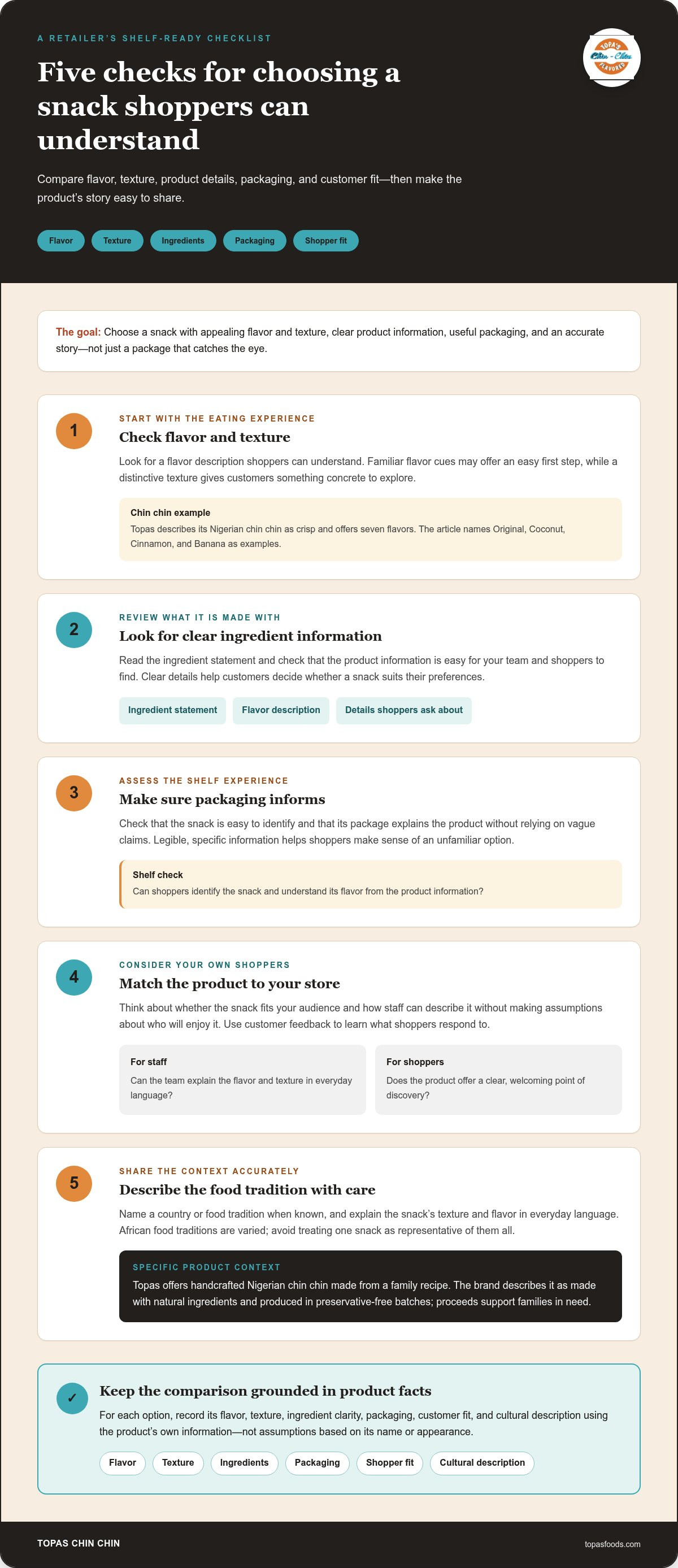
A five-step launch can keep the introduction manageable:
- Select: Choose the product or flavor range that fits your store and the discovery experience you want to create.
- Explain: Prepare a plain-language answer to “What is it?” and “How does it taste?” For chin chin, staff can describe it as a crisp Nigerian snack and point to the flavor names.
- Display: Place it where customers can notice it and read its description without searching for context.
- Listen: Pay attention to shoppers’ questions, the flavors they mention, and the information that would help them decide.
- Refine: Adjust the shelf wording or placement based on those conversations and the responses you observe.
Tell the product and purpose story with care
Once the snack itself is clear, share the maker’s story in a few accurate details. Topas chin chin is handcrafted from a Nigerian family recipe. Topas uses natural ingredients and makes preservative-free batches. These specifics give staff a grounded way to talk about the product’s craft and origin without making broad claims about African food.
The product also has a community purpose: proceeds support families in need. Share that mission plainly, without implying a specific donation amount or outcome. For more context, read how snack purchases support families.
Keep a few accurate talking points close at hand so your team can make the introduction their own: the snack’s Nigerian origin, its crisp texture, its flavor options, and the family recipe behind it. To explore a focused chin chin range for your retail selection, discover Topas wholesale chin chin.
Taking the Next Step with Wholesale African Snacks
A sound retail choice brings three things together: a product customers can enjoy, information your team can explain, and a story shared with care. That’s a useful way to narrow wholesale african snacks options while recognizing the many food traditions across Africa. Before deciding, consider how well a snack fits your assortment and the kind of discovery you want to invite.
A retailer’s final product-fit checklist
Use these questions to make your decision practical and clear:
- Can customers understand the flavor? Make sure flavor names and descriptions are easy to read and give shoppers a helpful starting point.
- Is the product information clear? Review the customer-facing details so staff can respond to questions accurately.
- Can you describe its cultural context respectfully? Be specific about the snack’s origin and avoid presenting one product as representative of an entire continent.
- Does it suit your store? Consider how the product complements your current snack selection and supports your goals for customer discovery.
- Can your team tell its story simply? A concise explanation of the maker, recipe, and purpose can make the product easier to introduce.
Answering these questions gives you a practical basis for introducing a new snack in an informative way. It also gives shoppers an easy opening to ask questions, compare flavors, and make their own choice.
Explore a wholesale chin chin partnership
For retailers interested in introducing Nigerian snacking, Topas offers handcrafted chin chin made from a Nigerian family recipe. The seven flavors are Original, Coconut, Cinnamon, Mocha Cappuccino, Banana, Vanilla, and Strawberry. The range centers on one snack while giving customers different flavors to discover.
Topas uses natural ingredients and makes preservative-free batches. The family-owned business connects its products with a community-support mission: proceeds support families in need. These details give retailers a clear, grounded story to share alongside the snack’s crisp texture and Nigerian roots.
If this focused range feels right for your store, explore Topas Chin Chin and learn more about its wholesale offering.
Choose a Snack Story Your Store Can Share
A thoughtful selection of wholesale african snacks starts with more than shelf appeal. Look for clear flavor and ingredient information, a product that fits your shoppers, and a story you can tell accurately and respectfully. Then make discovery easier with straightforward descriptions and a display that invites questions.
For retailers seeking a focused introduction to Nigerian snacking, Topas offers handcrafted chin chin made from a family recipe in seven flavors. The batches use natural ingredients and are preservative-free, and proceeds support families in need. It’s a crunchy snack with a heritage and purpose your team can share in a few simple words.
Explore wholesale Chin Chin from Topas to see how this family-crafted Nigerian snack could fit your store. A clear introduction can make room for new flavors, meaningful discovery, and a warm welcome at the shelf.
Frequently Asked Questions
What are wholesale African snacks?
Wholesale African snacks are snack products originating in Africa that retailers purchase from suppliers for resale. The category spans distinct countries, communities, food traditions, flavors, and formats, so products shouldn’t be treated as interchangeable or described as one cuisine. Introduce each snack with accurate details about its origin and eating experience. Nigerian chin chin is one example. Topas focuses on handcrafted chin chin made from a family recipe.
How do I choose wholesale African snacks for my store?
Compare flavor and texture, ingredient and packaging information, customer fit, and how easily your staff can explain each snack. Choose products that suit your assortment rather than relying on broad assumptions about shopper demand. Topas offers a focused range of Nigerian chin chin in seven flavors. For product-specific wholesale context, read the wholesale chin chin retailer’s guide before deciding how it may fit your store.
What is Nigerian chin chin, and how does it fit an African snack selection?
Nigerian chin chin is a snack known for its crisp texture, though its flavor and presentation depend on the product. It can give shoppers a specific, approachable introduction to Nigerian snacking, especially when a shelf description explains what it is and what to expect. Chin chin is one snack, not a stand-in for Africa’s many food traditions. Topas’s range centers on chin chin and its flavor variations.
Can unfamiliar African snacks appeal to customers who have not tried them before?
Clear descriptions can help first-time shoppers understand an unfamiliar snack, but customer preferences differ and sales results aren’t guaranteed. Use approachable flavor language, accurate cultural context, and a simple answer to “What is it?” and “How does it taste?” Then listen to the questions and reactions customers share. Those conversations can help you refine shelf wording, explain the product more clearly, and learn whether it suits your store’s shoppers.
What should retailers check before buying snacks wholesale?
Review the product identity, flavor descriptions, ingredient information, packaging details, and fit with your store’s assortment. Consider whether staff can explain the snack using clear, accurate information. Before ordering, understand the applicable wholesale purchasing details for the product, but don’t assume there’s a standard minimum order or case quantity. For regulatory or food-safety questions, consult current authoritative guidance that applies to your product and business rather than relying on general assumptions.
How can a retailer explain the story behind an African snack respectfully?
Name the specific country or food tradition when that information is supported, describe the snack accurately, and avoid broad claims about an entire continent. Ground the introduction in flavor, texture, and the maker’s story. For Topas, retailers can share that its chin chin is Nigerian, handcrafted from a family recipe, and connected to a mission whose proceeds support families in need. Don’t embellish that story with unverified outcomes.
Does Topas Chin Chin offer wholesale African snacks?
Yes. Topas offers wholesale partnerships for retailers featuring its handcrafted Nigerian chin chin. The range includes seven flavors: Original, Coconut, Cinnamon, Mocha Cappuccino, Banana, Vanilla, and Strawberry. The family recipe uses natural ingredients, and batches are preservative-free. Proceeds support families in need. Retailers can introduce the range as a focused selection of Nigerian chin chin and its flavor variations.


